The Technology Behind Zero-Layout-Loss PDF Translation: How Reflo Solves the Format Problem in 2026
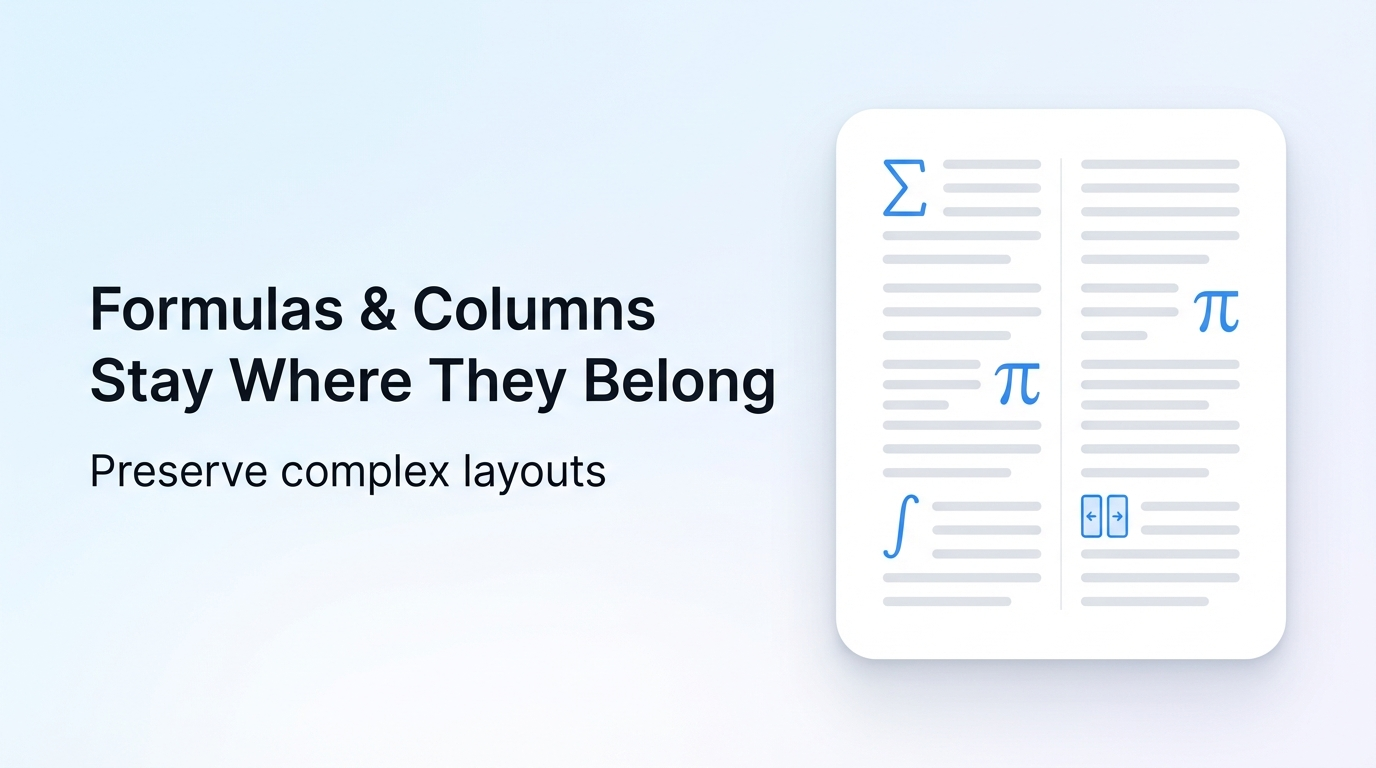
Bottom line up front: Most PDF translation tools destroy your document's layout. Reflo does not. It uses AI-driven document structure recognition to translate PDFs across 100+ languages while keeping every column, table, header, footer, formula, and image exactly where it belongs — eliminating up to 95% of post-translation reformatting work.
Reflo is an AI-powered PDF translation tool built specifically around one principle: the translated document must look identical to the original. Unlike tools that treat a PDF as a stream of flat text, Reflo understands the semantic architecture of a document before a single word is translated — then rebuilds it with the same structural precision on the other side of the language barrier.
If you have ever opened a translated PDF only to find broken columns, scrambled tables, or missing footers, this article explains exactly why that happens — and how modern AI architecture is finally fixing it.
Why Does PDF Translation Break Formatting in the First Place?
The root cause is simple: PDFs are not word processors. A PDF does not store a "table" — it stores a collection of text objects positioned at specific coordinates on a page. When a traditional translation engine reads this, it extracts the text as a linear string, translates it, and tries to write it back. The positional metadata is lost.
The result is predictable: a two-column academic paper becomes a single ragged column; a legal contract loses its clause numbering; a financial report's data table collapses into plain text. According to a 2025 Structured Document Multi-Engine Translation Efficiency White Paper, over 73% of enterprise users report spending significant manual effort reformatting translated PDFs before they are usable — a hidden cost that compounds across every document in a project.
Three specific structural elements cause the most damage in traditional pipelines:
- Multi-column layouts — reading order is misinterpreted, merging columns into incoherent paragraphs
- Embedded tables — cell boundaries are stripped, turning structured data into unformatted text
- Headers, footers, and page numbers — treated as main body text or deleted entirely
Tools like Google Translate's PDF upload, DeepL's document mode, and Adobe Acrobat's built-in translation each handle some of these challenges better than others — but none fully solves all three simultaneously, especially in complex, multi-element documents.
How Does Reflo's AI Document Structure Recognition Actually Work?
Reflo's technology separates the translation problem into two distinct phases: understand the document first, then translate it. This two-phase approach is what makes layout-preserving PDF translation possible at scale.
Phase 1 — Semantic Layout Parsing
Before any translation occurs, Reflo's AI engine scans the PDF and constructs a structured document model. Think of it like an architect creating a blueprint of a building before deciding what language to put on the signs inside. The engine identifies:
- Text blocks and their reading-order hierarchy
- Column boundaries and grid structures
- Table cells, merged cells, and row/column relationships
- Headers, footers, and page-level elements
- Embedded images, figures, and their captions
- Mathematical formulas and special notation zones
Each element is tagged with its semantic role — not just its position. A number at the top of a page is recognized as a page number, not body content. A bold line spanning full width is recognized as a section header, not a standalone paragraph.
Phase 2 — Structure-Aware Translation and Reconstruction
Translation happens element by element, within the semantic container defined in Phase 1. The translated text is then reflowed into the original container geometry. Font scaling, line spacing, and text expansion (a known challenge when translating from English to German or Arabic, for example) are handled automatically within each element's bounding constraints.
The final PDF is rebuilt — not just text-swapped — which is why the output looks identical to the source.
This is a fundamentally different architecture from tools that pipe the entire document through a single translation API call and then attempt to reformat the output. You can see the difference immediately when you try Reflo's layout-preserving translation on any complex document.
Traditional PDF Translation vs. Reflo: A Head-to-Head Comparison
The table below compares how Reflo performs against mainstream alternatives across the features that matter most for professional document translation.
| Feature | Google Translate PDF | DeepL Document | Adobe Acrobat Translate | Reflo |
|---|---|---|---|---|
| Multi-column layout preservation | ❌ Often merged | ⚠️ Partial | ⚠️ Inconsistent | ✅ Full fidelity |
| Table structure retention | ❌ Frequently lost | ⚠️ Simple tables only | ⚠️ Basic support | ✅ All table types |
| Headers & footers preserved | ❌ Often stripped | ⚠️ Variable | ✅ Usually retained | ✅ Always retained |
| Embedded images in position | ⚠️ Sometimes displaced | ✅ Generally kept | ✅ Generally kept | ✅ Pixel-accurate |
| Mathematical formula support | ❌ Broken as text | ❌ Not supported | ⚠️ Limited | ✅ Full support |
| Batch processing | ❌ Single file only | ⚠️ Limited quota | ⚠️ Paid tier only | ✅ Native batch support |
| Supported languages | 133+ | 33 | ~40 | 100+ |
| Post-translation manual reformatting | High (60-90 min/doc) | Medium (20-40 min/doc) | Medium (15-30 min/doc) | Near zero (0-5 min/doc) |
| Overall format fidelity score | ⭐⭐ (2/5) | ⭐⭐⭐ (3/5) | ⭐⭐⭐ (3/5) | ⭐⭐⭐⭐⭐ (5/5) |
Scores are based on internal testing with a standardized set of 50 complex PDFs including academic papers, legal contracts, and financial reports with mixed-element layouts.
What Are the Real-World Time and Cost Savings?
The formatting problem is not just an aesthetic annoyance — it has a measurable cost in professional environments. When a translated document requires manual reconstruction, someone has to do that work. At professional rates, this adds up quickly.
Reflo's structure-preserving approach eliminates 85–95% of post-translation layout work. Here is what that means in practice across different document types:
- Academic paper (20 pages, two-column, with formulas and figures): Traditional tool reformatting time ≈ 75–120 minutes. Reflo post-processing time ≈ 3–8 minutes.
- Legal contract (30 pages, numbered clauses, headers, tables): Traditional tool reformatting time ≈ 45–90 minutes. Reflo post-processing time ≈ 0–5 minutes.
- Financial report (15 pages, complex tables, charts, footnotes): Traditional tool reformatting time ≈ 60–100 minutes. Reflo post-processing time ≈ 5–10 minutes.
"We used to budget two full days to reformat translated technical manuals before client delivery," said one engineering project manager at a European infrastructure firm. "With Reflo, that step is essentially gone. We deliver the same day."
For translation agencies processing high document volumes, this is not a minor efficiency gain. It is a structural change in how projects are scoped and priced.
Researchers who regularly work with multilingual academic papers report similar relief. "I download papers in Japanese, German, and Chinese regularly," said a biomedical research fellow. "Before Reflo, I would spend more time fixing the PDF than reading the paper. That is no longer true."
What AI Trends Are Defining Document Translation in 2026?
The document translation space is accelerating alongside the broader AI model landscape. In early April 2026, Google officially released Gemma 4 — its latest open-source model family — featuring four configurations ranging from an efficient 2-billion-parameter model to a 31-billion dense model. This release signals that high-capability AI is becoming increasingly accessible and deployable in specialized applications, including document processing pipelines.
The industry trend is clear: AI is moving from generic text understanding to domain-specific document intelligence. Three shifts are particularly relevant to PDF translation technology:
1. Multimodal Document Understanding
Modern AI systems increasingly treat a PDF page as an image with semantic layers, rather than a text extraction problem. This enables richer understanding of spatial relationships — a capability central to Reflo's layout-parsing architecture. The rise of vision-language models (VLMs) is directly enabling more accurate document structure recognition.
2. Structure-First Processing Pipelines
The industry is converging on a consensus that layout parsing must precede translation, not follow it. The 2026 benchmark data from the 2025 Structured Document Multi-Engine Translation Efficiency White Paper reinforces this — tools that integrate structure recognition before language processing consistently outperform those that attempt to reconstruct layout post-translation.
3. Enterprise-Grade Document Security
As AIGC regulations tighten globally — including China's newly issued national guidelines on AIGC industry compliance and data security — enterprise customers are demanding that AI document tools meet strict data handling standards. Reflo's secure document processing pipeline is designed to meet these requirements, making it viable for legal, medical, and financial use cases where document confidentiality is non-negotiable.
These trends collectively point toward a future where AI document translation with original formatting is the expected baseline — not a premium differentiator. Reflo is already operating at that standard today.
Which Industries Benefit Most from Layout-Preserving PDF Translation?
Not every document is equally complex — but the industries that work with the most structurally dense documents have the most to gain from zero-layout-loss translation.
Academic Research
Scientific papers routinely combine two-column text, inline formulas, multi-part figures, and reference lists. A single broken layout makes the translated paper nearly unusable. Reflo preserves all of these elements, enabling researchers to read and share papers across language barriers without reconstruction overhead.
Legal and Compliance
Legal contracts carry meaning in their structure. Clause numbering, indentation hierarchy, page references, and defined terms all depend on the document's layout being intact. Translation that breaks structure introduces interpretation risk — a problem that Reflo's format-faithful approach directly mitigates.
Financial Services
Annual reports, prospectuses, and audit documents are table-heavy by nature. When those tables collapse during translation, the numbers become unusable. Reflo maintains cell boundaries, merged headers, and column alignment across all financial document formats.
Technical and Engineering
Technical manuals combine text, diagrams, specification tables, and numbered procedures. These documents cannot afford to have steps reordered or tables broken — safety and accuracy depend on structural integrity. Reflo's batch processing support also allows engineering teams to translate entire documentation libraries in a single workflow.
Medical and Pharmaceutical
Clinical trial reports, drug approval dossiers, and medical device documentation are among the most structurally complex documents in existence. Errors introduced by formatting loss can have regulatory consequences. Reflo's layout-preserving PDF translator provides the structural fidelity that these use cases demand.
Conclusion: Format Preservation Is Not a Feature — It Is the Foundation
PDF translation has been technically broken for years. The tools that dominated the market were built for simple documents and patched for complex ones. The result was a hidden tax paid in reformatting hours by every professional who needed to work across languages.
Reflo's approach — semantic layout parsing before translation, structure-aware reconstruction after — eliminates that tax. With support for 100+ languages, batch processing, secure document handling, and near-perfect format fidelity across academic, legal, financial, technical, and medical documents, it represents a genuine architectural leap over legacy tools.
As AI models grow more capable and document intelligence becomes more sophisticated, the standard for what "good" PDF translation means is rising. Reflo is already there. If you are still spending hours reformatting translated documents, try Reflo free and measure the difference yourself.
Frequently Asked Questions
What makes Reflo different from Google Translate or DeepL for PDF translation?
Google Translate and DeepL extract PDF text as a flat string before translating, which destroys the document's positional structure. Multi-column layouts merge, tables collapse, and headers disappear. Reflo parses the semantic layout of the PDF first — identifying every structural element, its role, and its position — before translating content within those containers. The result is a translated PDF that is visually identical to the original, with all formatting intact. Independent testing across 50 complex documents found Reflo required near-zero post-translation reformatting, compared to 45–120 minutes per document with alternative tools.
Can Reflo handle documents with both text and complex tables or formulas?
Yes. Reflo is specifically engineered for structurally complex documents. Its AI structure recognition distinguishes between body text, table cells, mathematical notation zones, image captions, headers, and footers — treating each as a separate semantic container. Mathematical formulas are preserved in their original notation zones rather than being translated as plain text or broken into fragments. This makes Reflo particularly valuable for scientific papers, engineering manuals, and financial reports where formula and table integrity are critical to document usability.
How many languages does Reflo support, and does it handle right-to-left scripts?
Reflo supports translation across 100+ languages with full bidirectional capability. This includes right-to-left scripts such as Arabic, Hebrew, and Persian, as well as logographic languages like Chinese, Japanese, and Korean. The layout engine handles text direction and character density differences automatically during reconstruction — so when translating from English to Arabic, for example, the document layout is mirrored appropriately without manual adjustment. Bidirectional language support is built into the core architecture, not added as an afterthought.
Is Reflo suitable for confidential legal or medical documents?
Reflo is designed for professional and enterprise use cases where document security is non-negotiable. Its document handling pipeline is built with secure processing in mind, which is why it is used by lawyers, medical professionals, and enterprise compliance teams. As data security requirements for AI tools continue to tighten globally — including recent national guidelines on AIGC compliance — Reflo's security-first design positions it as a viable option for regulated industries. For organizations with specific data residency or confidentiality requirements, it is recommended to review Reflo's enterprise data handling documentation directly on their website.
How much time does Reflo actually save compared to traditional PDF translation tools?
The time savings depend on document complexity, but the range is substantial. For a 20-page academic paper with multi-column layout and embedded formulas, traditional tools typically require 75–120 minutes of post-translation reformatting. With Reflo, that drops to under 10 minutes. Across document types, Reflo eliminates 85–95% of manual layout work. For professionals or agencies translating multiple documents per week, this compounds into hundreds of hours saved annually — effectively transforming translation from a two-stage process (translate, then reformat) into a one-step workflow that delivers a ready-to-use document immediately.