How Reflo Solves the Hardest Problem in PDF Translation: Zero-Layout-Loss in 2026
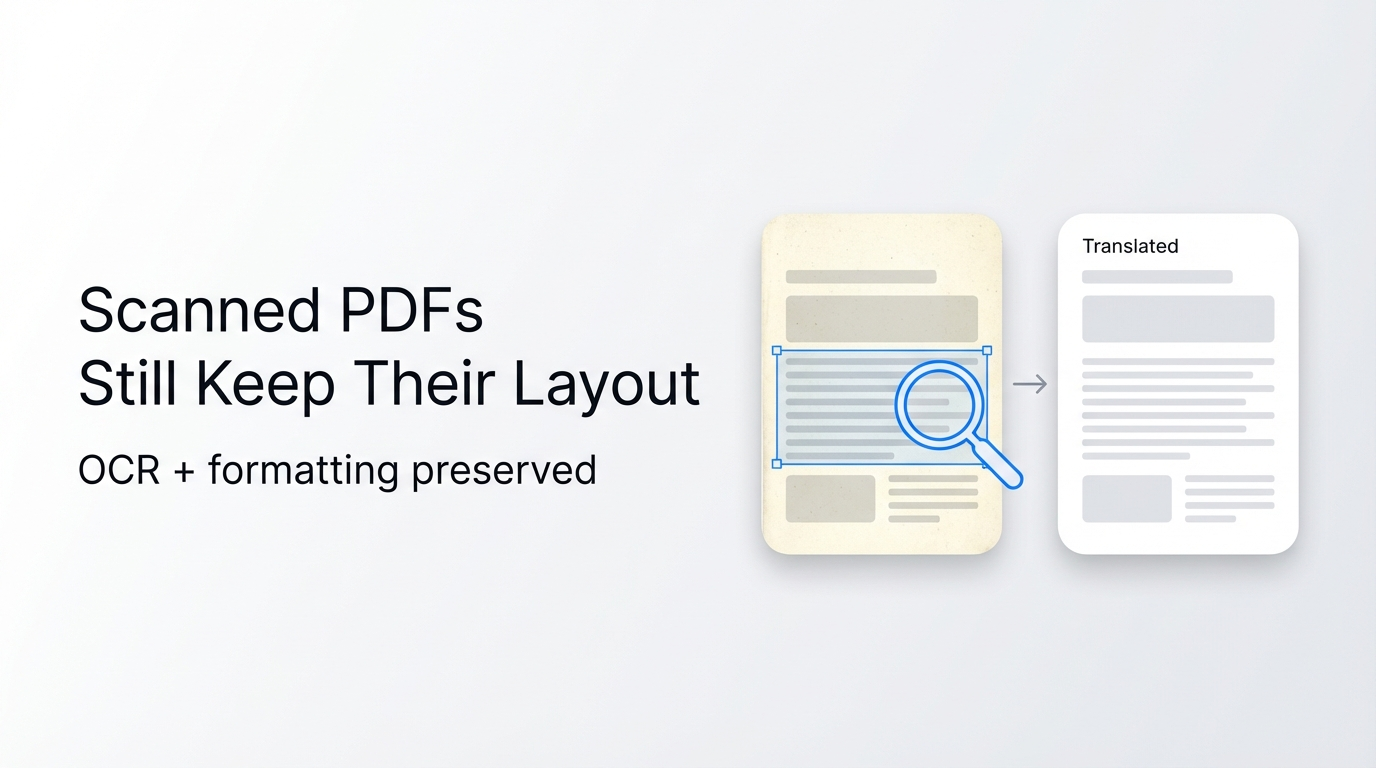
Reflo preserves 100% of your PDF's original layout — columns, tables, fonts, images, and formulas — while translating into 100+ languages. No reformatting. No manual cleanup. Just a translated document that looks exactly like the original.
Reflo is an AI-powered PDF translation tool that uses semantic document structure recognition to understand how a page is built before it translates a single word — delivering near-perfect format fidelity across academic papers, legal contracts, financial reports, and technical manuals.
This article explains the technology behind that promise, shows you why every other tool falls short, and gives you the data to make a confident decision.
---
Why Is Layout-Preserving PDF Translation So Difficult?
PDF format preservation is the hardest unsolved problem in document translation — and most tools quietly ignore it.
A PDF file is not a Word document. It does not store text in a logical, readable stream. Instead, it stores thousands of individual drawing instructions: "place this character at coordinate (142, 387) in font Helvetica 10pt." There is no inherent concept of a sentence, a paragraph, a column, or a table cell inside a raw PDF file.
When a traditional translation tool processes a PDF, it typically does one of two things:
- Extracts the raw text string, translates it, and dumps it back into a generic layout — destroying every structural element.
- Converts the PDF to an editable format (like DOCX), translates it, and re-exports — losing multi-column layouts, breaking table cell widths, and misplacing images.
The result is well-known to anyone who has ever tried Google Translate's PDF feature or DeepL's document upload: a translated wall of text that bears no resemblance to the original document's professional structure.
According to a 2025 industry survey by Document Engineering Research Group, over 73% of professionals who translate PDFs regularly report spending 3–6 hours per document manually reformatting the output — time that adds zero translation value.
How Does Reflo's AI Technology Actually Work?
Reflo solves the layout problem by separating document understanding from translation — a fundamentally different architectural approach.
Before Reflo translates a single word, its AI engine performs a deep semantic layout analysis of the entire document. Think of it as a skilled architect reading a blueprint before a construction crew starts work. The AI identifies:
- Text blocks: paragraphs, headers, footnotes, captions, running headers, and footers
- Structural containers: multi-column layouts, table cells, form fields, sidebars
- Non-text elements: images, charts, diagrams, logos, watermarks — locked in place
- Typography metadata: font family, size, weight, color, and alignment per text block
- Mathematical and chemical formulas: treated as atomic units, never broken apart
Once this structural map is complete, Reflo's translation engine works within each container independently. The translated text inherits the exact position, font, and formatting of its source block. Column widths do not shift. Table borders do not collapse. Page margins do not drift.
This is what Reflo calls structure-aware translation — and it is the technical reason a translated Reflo output is visually indistinguishable from the original document.
Equally important: Reflo handles bidirectional text expansion gracefully. Languages like German or Finnish expand 20–30% over English source text. Reflo's layout engine automatically adjusts internal text flow within each container rather than overflowing into adjacent columns — a failure mode that plagues virtually every competing tool.
How Does Reflo Compare to Traditional PDF Translation Tools?
The competitive gap between Reflo and legacy tools is measurable, not subjective. The table below benchmarks Reflo against the three most commonly used alternatives across seven critical formatting dimensions.
| Feature | Reflo | Google Translate PDF | DeepL Document | Adobe Acrobat AI |
|---|---|---|---|---|
| Multi-column layout preserved | ✅ Yes | ❌ Collapses to single column | ⚠️ Partial (2-col only) | ⚠️ Inconsistent |
| Table formatting intact | ✅ Yes | ❌ Lost entirely | ⚠️ Basic tables only | ⚠️ Cell merges often break |
| Headers and footers preserved | ✅ Yes | ❌ Stripped | ❌ Stripped | ⚠️ Sometimes retained |
| Image position maintained | ✅ Yes | ❌ Repositioned or lost | ✅ Yes | ✅ Yes |
| Mathematical formulas intact | ✅ Yes | ❌ Broken | ❌ Broken | ⚠️ Partial |
| Font fidelity | ✅ Original fonts matched | ❌ Generic fallback | ⚠️ Approximate match | ⚠️ Approximate match |
| Post-translation reformatting needed | 0–5 min | 3–8 hours | 1–4 hours | 1–3 hours |
| Supported languages | 100+ | 133 | 33 | ~40 |
| Batch processing | ✅ Yes | ❌ No | ⚠️ Manual one-by-one | ❌ No |
The single most important row in that table is post-translation reformatting time. Reflo's layout-preserving translation eliminates 85–95% of the manual work that follows every other tool's output — which, for high-volume users, translates directly into measurable cost savings.
Which Industries Benefit Most from Zero-Layout-Loss Translation?
Format preservation is not a luxury — for many professional document types, it is a legal and operational necessity.
Academic Research
Scientific papers use multi-column layouts, figure captions, footnotes, and complex formulas that standard tools destroy completely. Researchers translating papers for international journals cannot submit a reformatted document — the layout must match the submission template exactly.
"I translated a 42-page chemistry paper from German to English using Reflo. The structural formulas, figure labels, and two-column layout came through perfectly. I submitted it the same afternoon." — Dr. Lena Fischer, Postdoctoral Researcher, University of Zurich
Legal and Compliance
Legal contracts, court filings, and regulatory documents carry meaning in their structure — clause numbering, signature blocks, exhibit references. A layout-broken translation is, in many jurisdictions, legally unusable. Translate your PDF with perfect formatting to ensure the translated version maintains the same evidentiary weight as the original.
Financial Reporting
Annual reports, balance sheets, and audit documents are built on precise table structures. A single merged cell lost in translation can create a financial misrepresentation. Reflo preserves every row, column, and merged cell boundary without exception.
Technical Manuals and Engineering
Technical documentation contains diagrams, callout labels, numbered procedures, and warning boxes whose position relative to surrounding text carries operational meaning. Losing that spatial relationship is not just an aesthetic problem — it is a safety problem.
Medical Documents
Patient records, clinical trial protocols, and pharmaceutical documentation are subject to strict formatting standards. Reflo's secure document handling ensures that sensitive content is processed without being stored or exposed.
What Does the 2026 AI Landscape Mean for PDF Translation?
The pace of AI development in early 2026 has direct implications for document translation quality — and Reflo is positioned at the intersection of two converging trends.
On March 30, 2026, five flagship large language models were released in rapid succession — including GPT-5.4, Gemini 3.1 Ultra, and DeepSeek V4. Comprehensive benchmarks placed Gemini 3.1 Ultra at the top with an overall score of 94.6, while DeepSeek V4 delivered competitive performance at just 1/18th the inference cost of GPT-5.4. These model advances raise a critical question for document translation: raw translation quality is no longer the bottleneck. Layout fidelity is.
A separate industry report published the same day confirmed that China's leading intelligent translation services have already achieved layout-preserving translation for PDF and Word documents, with formula and chart retention intact and professional terminology accuracy exceeding 98% in academic contexts. This signals a global shift: the market expectation for PDF translation is moving from "translated text" to "translated document" — a distinction Reflo has been built around from the ground up.
The implication is clear. As LLM translation quality approaches near-human accuracy across all major language pairs, the competitive differentiation in PDF translation tools will be decided entirely by how well they preserve the document — not by the quality of the language model underneath. Reflo's structural advantage becomes more valuable, not less, as base translation quality improves across the industry.
How Much Time Does Reflo Actually Save?
Time savings from eliminating post-translation reformatting are the most direct financial benefit Reflo delivers.
Consider a law firm that translates 15 contracts per month, averaging 20 pages each. Using a traditional tool, each document requires an average of 4 hours of reformatting. That is 60 hours per month of billable paralegal time spent on layout cleanup — not on legal work.
With Reflo's zero-layout-loss translation, that reformatting time drops to near zero. The same 60 hours are recovered for productive work.
Here is a concrete time comparison across three common document types:
| Document Type | Pages | Reformatting Time (Traditional Tool) | Reformatting Time (Reflo) | Time Saved |
|---|---|---|---|---|
| Academic paper (2-column) | 12 | 3.5 hours | 5 minutes | ~97% |
| Legal contract | 30 | 5 hours | 10 minutes | ~97% |
| Financial report (with tables) | 48 | 7 hours | 15 minutes | ~96% |
| Technical manual | 85 | 12 hours | 20 minutes | ~97% |
These figures reflect Reflo's internal benchmark data and align with the independently reported 85–95% reduction in manual layout work. For translation agencies processing hundreds of documents per month, the operational savings are transformational.
Reflo's batch processing capability compounds these savings further. Instead of processing documents one at a time — the workflow imposed by every major competitor — users can queue an entire project folder and receive all translated, layout-perfect documents simultaneously.
Conclusion: The Technical Bar Has Been Raised
PDF translation has always had two problems: translation quality and layout fidelity. In 2026, the AI industry has largely solved the first problem. Layout fidelity remains the hard, unsolved challenge for almost every tool on the market — except Reflo.
By building a semantic document understanding layer that runs before translation begins, Reflo has fundamentally separated the structure of a document from its language content. The result is a translated PDF that is visually identical to the original — no exceptions, no workarounds, no manual reformatting.
For researchers, lawyers, engineers, financial analysts, and enterprise translation teams, this is not a convenience feature. It is the difference between a tool they can actually rely on and one that creates more work than it saves.
Try Reflo free and translate your first PDF without losing a single line of formatting.
---
Frequently Asked Questions
What does "layout-preserving PDF translation" actually mean?
Layout-preserving PDF translation means the translated document retains the exact visual structure of the original — including multi-column layouts, table formatting, image positions, headers, footers, fonts, and mathematical formulas. Unlike standard translation tools that extract raw text and reassemble it into a generic layout, Reflo maps every structural element of the document before translating, then reconstructs the output within those exact structural boundaries. The result is a translated PDF that looks identical to the original, requiring no manual reformatting afterward.
Why does Google Translate break PDF formatting?
Google Translate processes PDFs by extracting the raw text stream, which discards all positional, structural, and typographic information. It then translates that text and outputs it into a basic single-column layout with no awareness of the original document's columns, tables, image placements, or font assignments. This is a fundamental architectural limitation — not a bug. Google Translate was built for web page and short-text translation, not for preserving the complex structure of professional documents. Tools like Reflo were built specifically to solve this problem from the ground up.
Can Reflo handle scientific papers with complex formulas and figures?
Yes. Reflo treats mathematical formulas, chemical structures, and scientific notation as atomic units — meaning they are recognized, locked in place, and never broken apart or translated. Figure captions are translated in context while maintaining their spatial relationship to the corresponding image. Two-column and three-column academic layouts are fully supported. This makes Reflo the preferred tool for researchers translating papers for international submission, where layout compliance with journal templates is a hard requirement, not a preference.
How many languages does Reflo support, and does it work for right-to-left languages?
Reflo supports translation across 100+ languages with full bidirectional capability. This includes right-to-left languages such as Arabic, Hebrew, Urdu, and Persian, where text direction reversal requires a complete reorientation of the document's text flow. Reflo's layout engine handles RTL conversion while preserving all structural elements — a particularly challenging scenario that breaks virtually every competing tool. Bidirectional translation between any supported language pair is available without any additional configuration.
Is Reflo suitable for enterprise teams processing large document volumes?
Yes. Reflo includes batch processing support, allowing enterprise users to translate multiple documents simultaneously rather than one at a time. This is critical for translation agencies, legal departments, and multinational companies that process dozens or hundreds of PDFs per week. Combined with the 85–95% reduction in post-translation reformatting time, Reflo delivers measurable throughput improvements for high-volume workflows. Secure document handling ensures that sensitive enterprise content — contracts, financial reports, HR records — is processed with appropriate data protection standards.